
Prostate artery embolisation · Enlarged prostate
Is prostate artery embolisation right for me?
Prostate artery embolisation (PAE) is a minimally invasive treatment for an enlarged prostate, a common condition also known as benign prostatic hyperplasia or BPH.
If you have been reading about PAE, you may be wondering whether it is actually a good fit for your own situation.
Symptoms
Key symptoms, causes and suitability factors
Men with BPH often experience symptoms such as the following.
- A weak or slow urine stream happens when an enlarged prostate narrows the urinary pathway and reduces the force of your flow.
- Frequent urination throughout the day and night occurs because the bladder becomes overly sensitive as it works harder to push urine out.
- A feeling that the bladder has not fully emptied means residual urine remains behind because the obstruction prevents complete drainage.
- Straining to start urination occurs when the bladder muscle must exert extra pressure to overcome the blockage before flow begins.
- A sudden and strong urge to urinate develops when chronic irritation causes involuntary spasms in the bladder lining.
Clinical note: These symptoms occur because the enlarged prostate presses on the urethra, the tube that carries urine out of the body. Beyond symptoms alone, suitability for PAE also depends on factors such as prostate size, general health and the condition of the arteries supplying the prostate.
Clinical analysis
Diagnosis and treatment options
What is PAE?
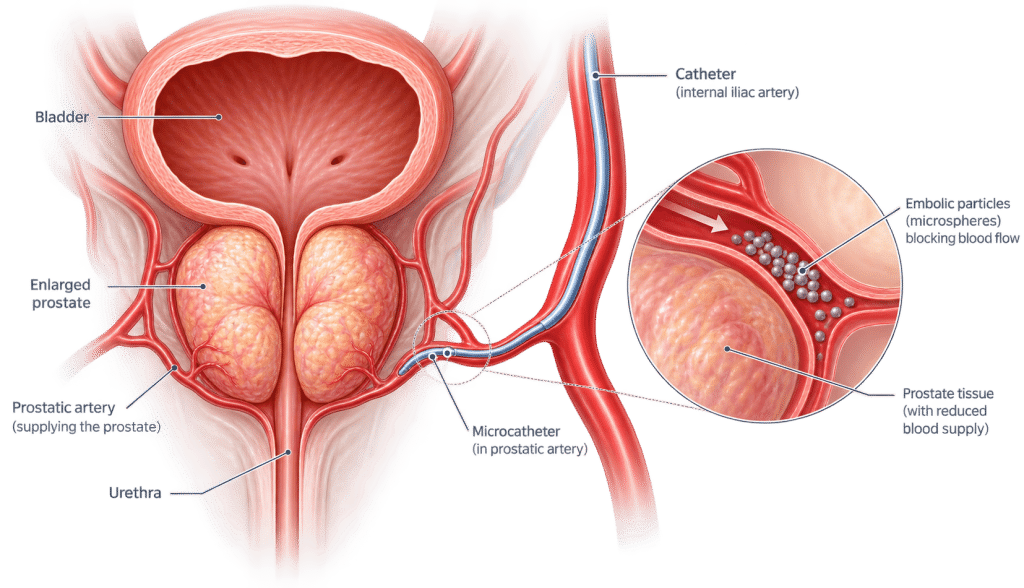
PAE is performed by an interventional radiologist. A thin catheter is guided into the small arteries that supply blood to the prostate, and tiny particles are released to reduce blood flow to the enlarged tissue. Over time, the treated tissue gradually shrinks. The procedure is usually done with local numbing medicine and light sedation, without any incision, and most patients go home the same day.
Tests used to assess eligibility
Before recommending PAE, your doctor will usually arrange a series of tests to confirm the diagnosis and check whether the procedure is technically possible. These commonly include the following.
- A PSA blood test
- Urine testing
- Ultrasound or urodynamic testing to assess bladder function
- CT angiography to map the prostate arteries
- Prostate MRI where appropriate
Clinical note: CT angiography is particularly important, since it shows the size, shape and condition of the prostate arteries and helps confirm whether they are suitable for the catheter based approach used in PAE.
Clinical evaluation
Assessing suitability for PAE
Prostate size and PAE
PAE can be considered across a range of prostate sizes, and it is sometimes suggested as an option for larger prostates where other minimally invasive treatments may be less suitable. That said, prostate size alone does not determine suitability. Your overall symptoms, imaging results and artery anatomy all play a role in the final assessment.
When PAE may not be suitable
PAE may not be recommended when the prostate arteries are not suitable for catheter access, when there are certain bladder or urinary conditions unrelated to prostate size, or when other causes of urinary symptoms have not yet been ruled out. Some general health conditions may also affect whether PAE or another treatment is the safer option. Your specialist will review your test results to determine whether any of these apply to you.
How suitability is confirmed
Suitability is generally confirmed through a combination of your symptom history, physical examination, blood and urine tests, and imaging of the prostate and its arteries. This thorough assessment helps ensure that PAE is both appropriate for your symptoms and technically achievable before the procedure is planned.
Clinical guidance
When to see a doctor
Speak with a doctor if you have ongoing urinary symptoms such as a weak stream, frequent nighttime urination or difficulty starting urination, particularly if these symptoms are affecting your daily life.
Learn about prostate artery embolisation →Consultation
Discuss your findings with Dr McConnell
Dr Ryan McConnell can review your symptoms, test results and imaging with you, explain whether PAE may be suitable, and discuss how it compares with other treatment options for an enlarged prostate.

FAQs
Frequently asked questions about PAE
What is prostate artery embolisation and how is it performed?
Will I need an incision or an overnight stay?
What tests will I need to find out if PAE is suitable for me?
Does the size of my prostate decide whether PAE is right for me?
Prostate artery embolisation
Learn more about prostate artery embolisation
Read about how PAE is performed, recovery, risks and how it compares with other treatments for an enlarged prostate.