
Image-guided venous access
Venous access procedures
Venous access devices provide reliable access to the bloodstream when medications, chemotherapy, intravenous treatment, blood sampling or other therapies are required over a period of time.
Dr Ryan McConnell performs image-guided venous access procedures including PICC insertion, Port-a-Cath insertion and other central venous access procedures.
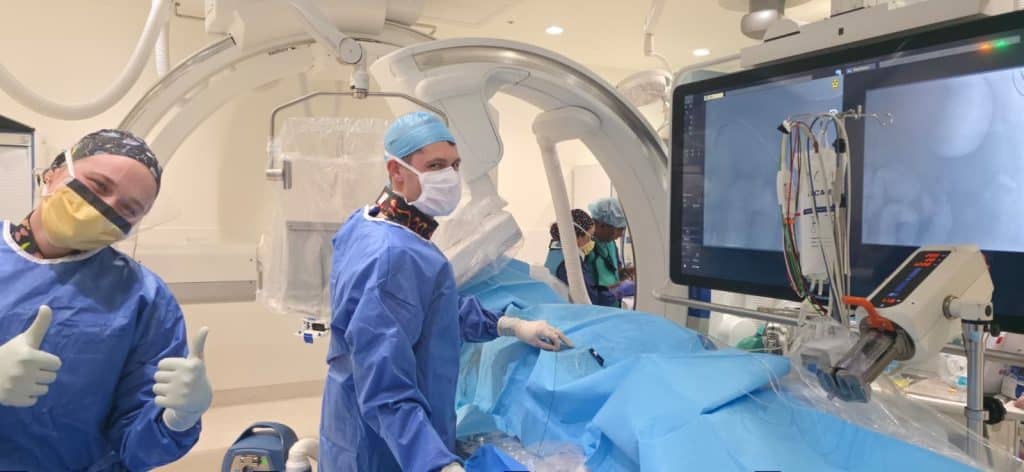
Ultrasound and X-ray guidance are used to select an appropriate vein, guide catheter placement and confirm the final position of the device.
Venous access options
Which type of venous access may be required?
The most appropriate venous access device depends on why access is required, the expected duration of treatment and how frequently the device will be used.
PICC insertion
A peripherally inserted central catheter (PICC) is a thin catheter inserted through a vein in the upper arm and advanced until its tip lies in a large central vein.
A PICC can provide venous access for treatments that may be required over weeks or months and avoids the need for repeated peripheral cannulation.
Learn about PICC line insertion →Port-a-Cath insertion
A Port-a-Cath, or implanted venous port, is a small device placed beneath the skin and connected to a catheter positioned within a central vein.
Because the port sits completely beneath the skin when it is not being accessed, it can be useful when reliable venous access is required repeatedly over a longer period.
Other central venous access
Other forms of central venous access may be appropriate depending on the clinical circumstances.
The referring medical team and interventional radiologist can determine the most suitable form of access based on the treatment required and the patient's individual circumstances.
Image-guided placement
How is venous access performed?
Venous access procedures are performed using imaging to guide placement of the catheter.
Ultrasound allows the target vein to be identified and accessed directly. X-ray guidance can then be used to guide the catheter through the veins and confirm its position.
The exact technique varies according to the type of device being inserted. Local anaesthetic is used at the access site, with additional sedation or anaesthesia used when appropriate for the procedure and individual patient.
Once the device has been positioned, it is secured or implanted according to the type of access being used.
Choosing venous access
PICC or Port-a-Cath?
There is no single venous access device that is best for every patient.
PICC
A PICC is inserted through a vein in the arm and has an external portion that remains outside the skin. It may be suitable when central venous access is required for a defined period without the need for an implanted device.
Port-a-Cath
A Port-a-Cath is implanted completely beneath the skin. It requires a small procedure to insert and remove, but can provide convenient intermittent access when treatment is required over a longer period.
The choice depends on factors including:
- the type of treatment being given
- how frequently venous access is required
- the expected duration of treatment
- the condition of the available veins
- previous venous access devices
- individual clinical circumstances and patient preference
The treating medical team will usually determine the type of access required, with the interventional radiologist reviewing the planned procedure and relevant imaging or clinical information before insertion.
Your procedure
What to expect on the day
01
Preparation
→
02
Image-guided insertion
→
03
Position confirmed
→
04
Aftercare
Before the procedure, the clinical team will review the reason for venous access, relevant medical history and any previous difficulties with venous access.
You will receive instructions about preparation, including whether fasting is required and whether any medications need to be adjusted.
During the procedure, imaging is used to guide placement of the catheter. Local anaesthetic is used to numb the access site. Sedation or anaesthesia may also be used when appropriate.
After the procedure, the device and insertion site will be checked and you will receive instructions about caring for the access site or device.
Many venous access procedures are performed as day procedures, although arrangements depend on the procedure, treatment being provided and individual clinical circumstances.
Preparing for your procedure →Risks & considerations
What are the risks of venous access procedures?
Venous access procedures are routinely performed, but all procedures have potential risks.
Less commonly, complications can occur during central venous access because of the surrounding structures. The specific risks depend on the type and site of access.
Before the procedure, the relevant risks and alternatives will be discussed in the context of the device being inserted and your individual circumstances.
Depending on the device and individual circumstances, these may include:
- bruising, bleeding or discomfort at the insertion site
- infection
- thrombosis or narrowing of the vein
- catheter blockage, movement or malfunction
- difficulty obtaining suitable venous access
- reaction to medications or contrast if these are required
Recovery & device care
After your venous access procedure
Recovery and ongoing care depend on the type of venous access device inserted.
You will receive instructions about caring for the insertion site, dressing or implanted device and when it can be used.
PICC lines require ongoing care of the external catheter and dressing. Implanted ports remain beneath the skin and require appropriate access and maintenance when they are being used.
Contact your treating team if you develop increasing pain, redness, swelling, discharge or fever, or if there is a problem using the device.
Referrals
Referring for venous access
Referrals are accepted for PICC insertion, Port-a-Cath insertion and other image-guided central venous access procedures.
Please include the indication for venous access, the type of device requested where known, relevant medical history and details of the treatment for which access is required.
If the most appropriate type of venous access is uncertain, this can be discussed based on the clinical indication and expected duration of treatment.
Frequently asked questions
Frequently asked questions about venous access
What is a PICC line?
What is a Port-a-Cath?
What is the difference between a PICC and a Port-a-Cath?
Will I be awake during the procedure?
Can the venous access device be used immediately?
How long can a PICC or Port-a-Cath remain in place?
How is a venous access device removed?
Venous access
Need a venous access procedure?
Dr Ryan McConnell provides image-guided PICC, Port-a-Cath and central venous access procedures for patients referred by their treating medical team.
For referral information or to discuss an upcoming procedure, contact the practice.