
Vascular & endovascular treatments
Vascular & endovascular treatments in Sydney
Dr Ryan McConnell provides specialist assessment and minimally invasive, image-guided treatment for a range of arterial and venous conditions.
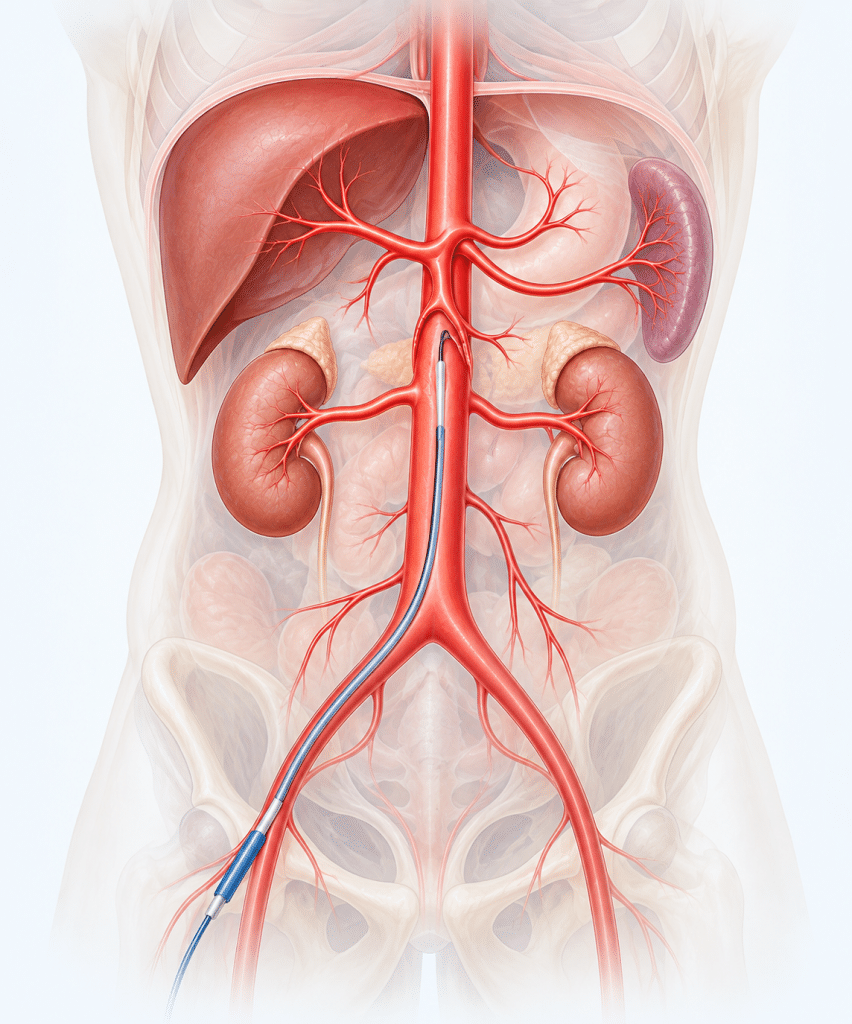
Interventional radiology allows many vascular conditions to be investigated or treated from within the blood vessels using small catheters and advanced medical imaging. Depending on the condition, treatment may involve embolisation, angioplasty, stenting, sclerotherapy or other targeted techniques.
Vascular conditions
Conditions treated with interventional radiology
Interventional radiology can be used to treat a wide range of arterial and venous conditions. The most appropriate approach depends on the underlying condition, its location and anatomy, your symptoms and your overall health.
Visceral artery aneurysms
Visceral artery aneurysms are abnormal enlargements of arteries supplying organs within the abdomen, including the spleen, liver, kidneys and bowel.
Renal artery stenosis
Renal artery stenosis is narrowing of one or both arteries supplying the kidneys. In selected patients, significant narrowing may contribute to difficult-to-control high blood pressure or impaired kidney function.
Learn about renal artery stenosis →Vascular malformations
Vascular malformations are abnormal collections or connections of blood vessels that can occur throughout the body and may cause pain, swelling, bleeding or functional problems.
Learn about vascular malformations →Arterial bleeding & pseudoaneurysms
Interventional radiology can be used to identify and treat many forms of arterial bleeding and pseudoaneurysms using targeted catheter-based techniques.
Varicose veins & venous insufficiency
Varicose veins occur when superficial veins become enlarged and their valves no longer function effectively, allowing blood to pool within the leg.
Visit Vein Doctors Sydney ↗Endovascular aneurysm treatment
Treating visceral artery aneurysms from within the blood vessels
Visceral artery aneurysms can affect arteries supplying organs such as the spleen, liver, kidneys and bowel. Many are discovered unexpectedly when CT or other imaging is performed for another reason.
Not every visceral artery aneurysm requires treatment. The decision to monitor or treat an aneurysm depends on factors including the artery involved, aneurysm size and characteristics, symptoms, changes over time and individual patient factors.
When treatment is recommended, an interventional radiologist can often reach the aneurysm by passing a small catheter through the arterial system.
Depending on the anatomy, treatment may involve coil embolisation, other embolic materials, covered stents or a combination of techniques. The aim is to exclude the aneurysm from the circulation while preserving important blood supply where possible.
Discuss visceral artery aneurysm treatment →
Renal vascular disease
Renal artery stenosis and endovascular treatment
Renal artery stenosis is narrowing of one or both arteries supplying the kidneys. It is most commonly caused by atherosclerosis, although other conditions such as fibromuscular dysplasia can also affect the renal arteries.
Many people with renal artery stenosis do not require an intervention. In selected patients, however, significant narrowing may contribute to difficult-to-control high blood pressure, deterioration in kidney function or recurrent episodes of acute pulmonary oedema.
Assessment usually involves reviewing your symptoms, blood pressure, kidney function and imaging to determine whether the renal artery narrowing is clinically significant and whether treatment is likely to be appropriate.
When intervention is indicated, renal artery angioplasty — sometimes with stent placement — can be performed through a small catheter inserted into an artery, without the need for open surgery.
Learn about renal artery stenosis →
Embolisation & sclerotherapy
Minimally invasive treatment of vascular malformations
Vascular malformations are abnormal blood vessels that develop before birth and may involve arteries, veins, lymphatic vessels, or a combination of these. They can occur almost anywhere in the body and may cause pain, swelling, bleeding, skin changes or other symptoms depending on their location and type.
Treatment depends on the type of vascular malformation, its anatomy and the symptoms it is causing. In selected patients, an interventional radiologist can treat the abnormal vessels using image-guided techniques such as embolisation or sclerotherapy, delivered through a small catheter or needle. Treatment may sometimes require more than one procedure.
Learn about vascular malformations →
Targeted embolisation
Treating arterial bleeding and pseudoaneurysms
Embolisation can be used to control bleeding or treat a pseudoaneurysm by targeting the affected artery from within the blood vessels. Using real-time X-ray imaging, a small catheter is guided to the abnormal vessel so it can be treated without open surgery.
01
Arterial bleeding
Arterial bleeding may occur following trauma, surgery or another medical procedure, or occasionally without an obvious cause. Angiography can identify the bleeding vessel and allow treatment during the same procedure.
02
Catheter-directed treatment
A small catheter is guided through the arterial system to the vessel responsible for the bleeding or pseudoaneurysm. This allows treatment to be delivered directly to the affected area.
03
Embolisation
Depending on the location and anatomy, coils, particles, liquid embolic agents or other techniques may be used to stop bleeding or exclude a pseudoaneurysm from the circulation.
Vein care
Varicose and spider veins
Varicose veins develop when superficial veins become enlarged and their valves no longer function effectively, allowing blood to pool within the leg.
Dr Ryan McConnell assesses and treats varicose and spider veins through Vein Doctors Sydney, a dedicated vein practice.
Visit Vein Doctors Sydney ↗
Specialised procedures
Other vascular & endovascular procedures
Adrenal vein sampling
Highly specialised diagnostic sampling to accurately lateralise aldosterone excess prior to surgical management.
Angioplasty & stenting
Minimally invasive restoration of critical arterial flow using balloons and, where appropriate, vascular stents.
Diagnostic angiography
Advanced image-guided vascular assessment used to define vascular anatomy and guide appropriate treatment.
Minimally invasive vascular care
Treating vascular conditions using image guidance
Interventional radiology uses medical imaging to guide minimally invasive procedures through small catheters, wires and needles. This allows vascular conditions to be assessed and treated from within the blood vessels, often without the need for open surgery.
Image-guided
Procedures are performed using imaging such as fluoroscopy, ultrasound and CT to navigate catheters and other devices accurately within the blood vessels.
Minimally invasive
Many vascular procedures can be performed through a small puncture in an artery or vein, avoiding the larger incisions required for open surgery.
Targeted
Treatment can be delivered directly to the abnormal blood vessel or affected area while limiting treatment of surrounding tissues.
Individualised
The treatment approach is planned according to each patient’s condition, vascular anatomy, imaging findings and individual circumstances.
Specialist assessment
What to expect at your consultation
Your consultation begins with understanding your symptoms, reviewing your investigations and discussing what you hope to achieve. Dr Ryan McConnell will assess whether an interventional radiology procedure may be appropriate and explain the available treatment options.
Where a procedure is being considered, he will discuss what it involves, the expected recovery, potential benefits and risks, and the next steps in your care.
- Review of your symptoms and medical history
- Review of relevant imaging and investigations
- Assessment of appropriate treatment options
- Discussion of the procedure, recovery, benefits and risks

Patient resources
Frequently asked questions
What is peripheral artery disease (PAD) and how is it diagnosed?
What vascular conditions can be treated by an interventional radiologist?
What minimally invasive vascular treatments does Dr Ryan McConnell perform?
What is angioplasty and stenting?
What is adrenal vein sampling and why is it performed?
How long does recovery take after an endovascular procedure?
What can I expect during my initial specialist consultation?
Do I need a referral to see Dr Ryan McConnell?
Vascular assessment
Need an assessment for a vascular condition?
If you have been diagnosed with, or are being investigated for, a vascular condition, Dr Ryan McConnell can review your imaging and discuss whether an image-guided procedure may be appropriate.