
Article · Prostate health
PAE vs TURP: comparing treatments for an enlarged prostate
An enlarged prostate is a common condition that affects many men as they get older. Doctors often call it benign prostatic hyperplasia, or BPH. BPH is not cancer. It happens when the prostate gland grows larger and presses on the urethra, the tube that carries urine out of the body.
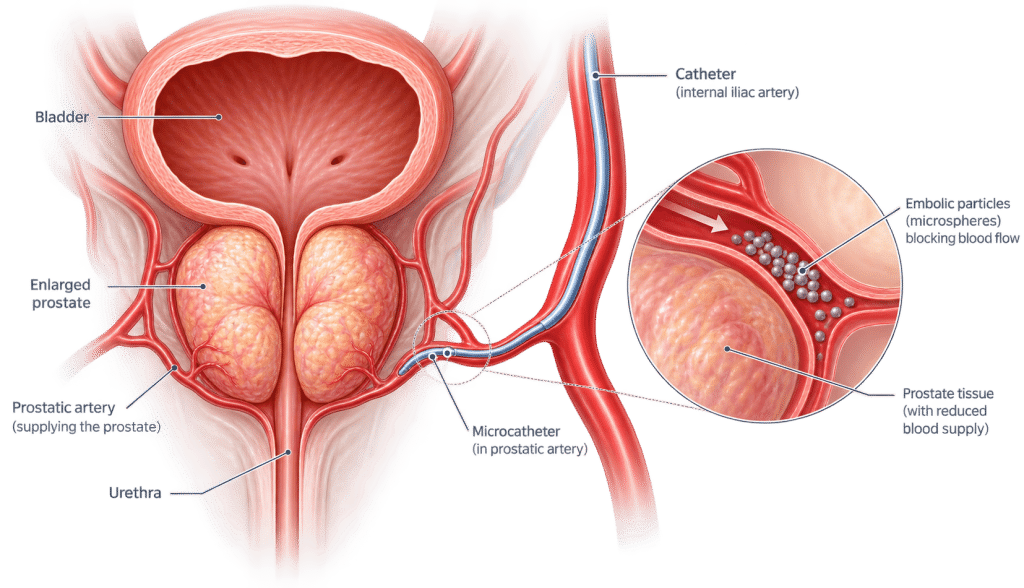
This pressure can cause frustrating urinary symptoms. Many men eventually look into treatment, and two options that often come up are prostate artery embolisation (PAE) and transurethral resection of the prostate (TURP).
These two treatments work in very different ways. Understanding those differences can help you feel more confident when you discuss your options with a specialist.
Symptoms of an enlarged prostate
Men with BPH may notice one or more of the following:
- a weak or slow urine stream
- needing to urinate often, especially at night
- a feeling that the bladder has not fully emptied
- straining to start urination
- a sudden, strong urge to urinate
Treatment is usually considered when symptoms start to affect daily life, sleep or comfort.
How is an enlarged prostate assessed?
Before recommending a treatment, your doctor will review your symptoms and arrange tests. These commonly include a PSA blood test, a urine test, and an ultrasound or urine flow test. If PAE is being considered, CT angiography is used to map the prostate arteries, and a prostate MRI may be arranged where needed.
What is prostate artery embolisation (PAE)?
PAE is performed by an interventional radiologist. A thin tube called a catheter is guided through a small puncture in an artery into the small arteries that supply the prostate. Tiny particles are then released to reduce blood flow to the enlarged tissue, allowing it to shrink gradually over time.
PAE is usually done with local anaesthetic and light sedation. It does not involve removing prostate tissue, and most patients go home the same day.
What is transurethral resection of the prostate (TURP)?
TURP is a surgical procedure performed by a urologist. Excess prostate tissue is removed through the urethra using an instrument passed into the bladder, without an external incision. It is usually performed under general or spinal anaesthetic. TURP has been used for many years and remains a well-established treatment for urinary blockage caused by an enlarged prostate.
How do PAE and TURP compare?
Both treatments can improve urinary symptoms. Research shows that TURP tends to produce larger improvements in measured outcomes such as urine flow. Clinical guidelines describe PAE as an option for carefully selected men who prefer a less invasive approach, while understanding that some results may not be as pronounced as after TURP.
Recovery
PAE is usually a day procedure. Mild stinging when passing urine, temporary urinary frequency, and occasional light blood in the urine or semen can occur in the first few days.
TURP usually involves a hospital stay and a urinary catheter for a short period afterwards. Return to normal activity depends on the individual and the surgical approach used.
Sexual function
TURP commonly causes retrograde ejaculation, where semen passes back into the bladder rather than out of the body. PAE generally has a lower risk of affecting ejaculation because prostate tissue is not removed through the urethra. If this is important to you, discuss it with your doctor when comparing options.
When should you see a doctor?
Speak with a doctor if you notice ongoing urinary symptoms such as a weak stream, frequent night-time urination or difficulty starting urination. Seek prompt medical attention if you are unable to pass urine, notice blood in your urine, or develop fever, chills or severe pelvic pain.
Next steps
Discuss your options with Dr Ryan McConnell
Dr McConnell can review your symptoms, test results and imaging and discuss whether PAE may be suitable, working alongside your GP and urologist.